
Campobello
Eva-Maria Bertschy (Palermo / Basel)
German premiere | Co-production | French, Italian and Bambara with German surtitles | Recommended for ages 14+ | Audio description on 8 NOV
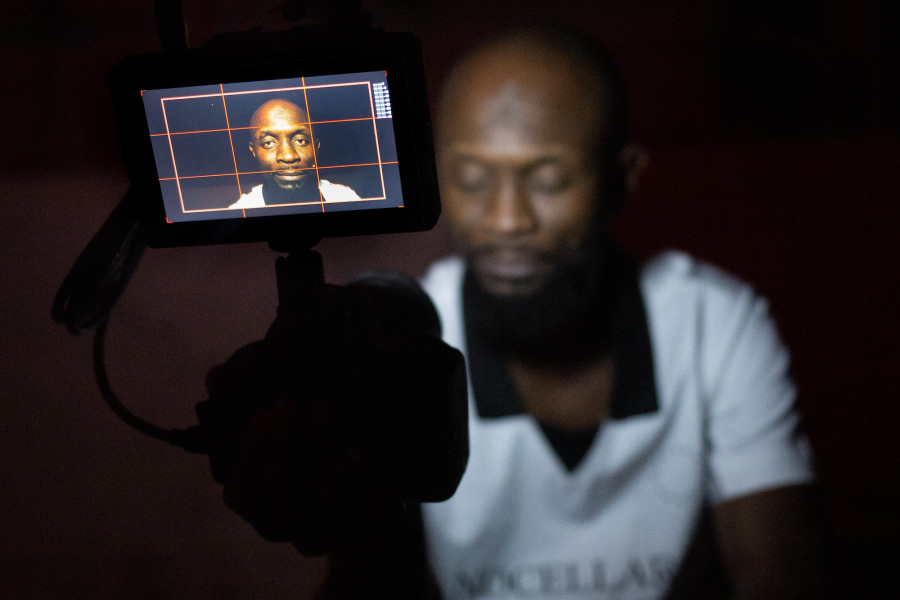
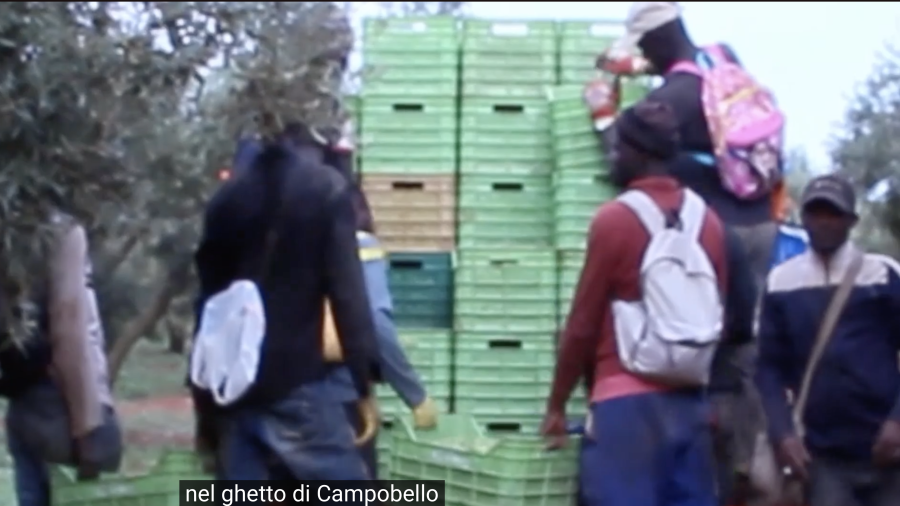
The large green olives from the small Sicilian town of Campobello are considered a delicacy around the world and find their way onto our tables too. They are picked by thousands of migrant seasonal workers who travel to southern Italy for the harvest each year. Their labour is indispensable, yet they live in precarious conditions and, as workers in European agriculture, usually remain invisible.
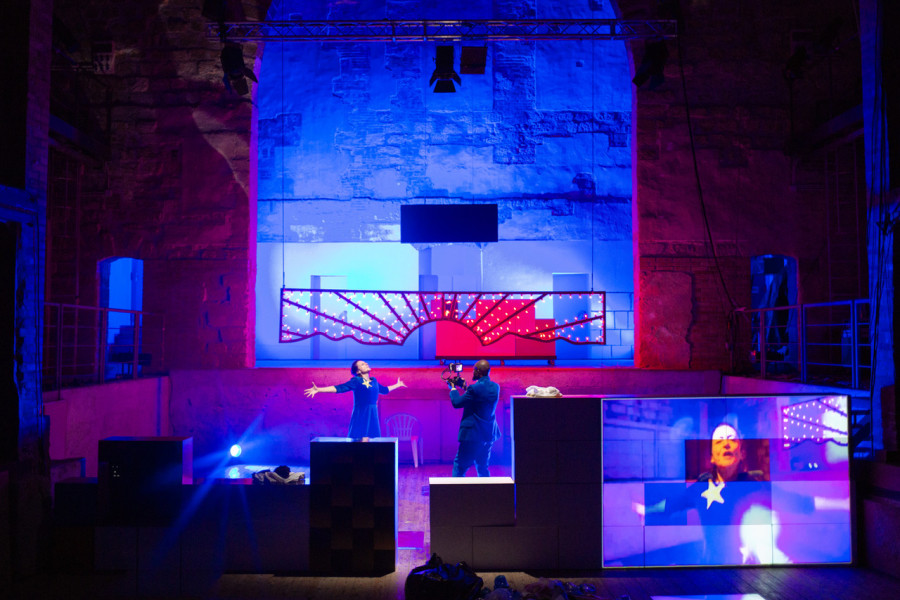
Drawing on more than two years of research on the ground, Swiss theatre-maker Eva-Maria Bertschy, Malian filmmaker Abou Bakar Sidibé and Sicilian actor Daniela Macaluso investigate precarious working conditions and mafia involvement in the olive harvest. Documentary testimony, live music and fictional storytelling combine in a compelling evening of theatre.
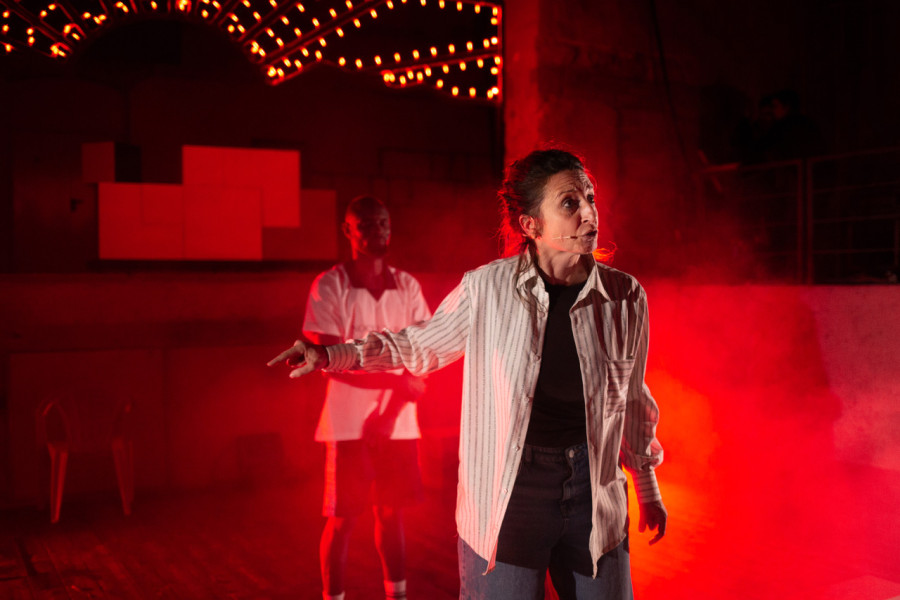
At the center are Simona and Amadou, whose paths cross in Campobello. Their love becomes political because it challenges an order founded on inequality, institutional racism and economic exploitation. Together with others, they resist a system that needs their labour while devaluing their lives. Their resistance and their struggle for a dignified life are repeatedly undermined, until institutional failures have life-threatening consequences.
CAMPOBELLO tells the stories of the people behind our food and the power structures that perpetuate this inequality. At the same time, the piece portrays a Europe full of contradictions: a continent that depends on migrant labour yet all too often denies the people doing that work security, rights and a sense of belonging.
On Sunday, 8 November: with Audiodescription + tactile guidance
For people with visual impairments, we offer audio description (AD) for some plays. This describes live what can be seen on stage, such as the plot and the stage and costume design. The audio description begins approximately one hour before the start of the performance with a tactile stage tour and the feeling of costume parts and props. You will then be given an audio receiver and headphones, the operation of which will be explained to you. Then an audio introduction to the play and the production begins. During the performance, professional speakers describe the visual events on stage live from a soundproof booth using the audio script.
The free audio description service can be used by approx. ten people per performance. Please register for this service when purchasing tickets at the festival box office:
e-mail: tickets@euro-scene.de
phone: 0341-217 16 48.
If you would like to take part in the tactile tour, please register with the evening staff one hour before the performance begins. If you are coming directly to the performance, please be there 20 minutes before the start so that the evening staff can accompany you into the auditorium and familiarise you with the audio receiver.
More information: https://euro-scene.de/en/accessibility
Essay by Anna Bertram: CAMPOBELLO IS NOT A HASHTAG
Capitalism has established something brilliantly paradoxical within its own logic: the appropriation of resistance – and, with it, the hollowing out of that very resistance. Today, everything is political. Theatre, art, relationships, food, clothing. The transition to greenwashing, pinkwashing and diversity washing is smooth and comfortable. In this way, positivity can be complacently wrapped around oneself through everyday consumption. Theatre, too, has learnt how to present itself as progressive: add a #political, efficient communication and target-group marketing, and the question of relevance is already settled. Afterwards, an apéritif with a few taralli and Nocellara olives; in Zurich, oysters and Prosecco also go down well on the premiere table. After all, in these difficult times it is important to do something nice for oneself.
But if everything is political, then nothing is political any longer. Artistic actions that understand themselves as urgent therefore sometimes remain – almost inadvertently – without structural consequences. And not even out of ill will. Rather, because attention is mistaken for change, or because moral positioning suddenly takes the place of action. It is precisely here, in the midst of the desire for urgency and its simultaneous commodification, that a fine crack opens up: between the paradoxical logic of exploitation and the fault line of the political. Because here, even our innermost desire for justice becomes marketable – and the cultural sector is no exception.
The question for theatre, then, is this: what does the term “political” mean for the stage beyond its marketability? What kind of text, and what kinds of bodies, do not dissolve into discourse and affirmation, but carry within them a genuine explosive force?
In CAMPOBELLO, Eva-Maria Bertschy’s theatre finds a language and a form of action that are both poetic and strikingly direct. And it does so at a time when precarity has been displaced to places where bourgeois theatre rarely ventures. Bertschy and her team know the terrain they are speaking about. They have lived there, documented it and carried out research: in the village of CAMPOBELLO in south-western Sicily, where workers are employed in the olive groves under exploitative conditions, and where politics and business deliberately force them into dependent and dangerous working arrangements. They also tell of solidarity and love, which exist there too – and which are powerful and resistant. Of stories that articulate themselves because they have to. The production condenses a material reality of violence and racism. And yet, in its ultimate consequence, it is an evening about connection and solidarity. CAMPOBELLO not only reveals and reconstructs the links between Europe and North Africa, but also those between “you” and “me”. And ultimately, it also tells of the connection between the Swiss bella vita – who does not love Italo-pop? – and the very real price paid for it.
The social problem behind Western prosperity is, however, greater than mere ignorance. It is not that knowledge about global exploitation is lacking in the relevant places. Quite the opposite: we actually know all too well that, in the places where Europe likes to spend its summer holidays, working conditions in agriculture are directly connected to our consumption and to forms of exploitation that are economically intended. We know all too well that the history of migration between Europe and its former colonies in Africa continues there as a merciless reality: in raw violence and oppression. But all of this is difficult to bear, uncomfortable – it hurts and overwhelms us. Faced with all the information about our own entanglements, within which it has become almost impossible to find one’s bearings, it is easier to look away. Pop-inflected discursive theatre then seems less irritating than an admonishing finger; surely one should not have to confront global interconnections in one’s leisure time as well.
The political capacity of emotional involvement to mobilise has been exhausted; it no longer works. Successful repression, on the other hand, does. And as state and institutional policies increasingly shift these issues to Europe’s external borders, global conflicts are also disappearing more and more from individuals’ screens – and consequently from cultural institutions as well. CAMPOBELLO resists precisely this: being dissolved in the spin cycle of the neoliberal, content-free washing machine. The production brings into the theatre the reality we no longer see here. Rather than reconstructing politics merely through facts and documents, CAMPOBELLO creates politics on stage with a certain gentleness. Through bodies, voices, time and space.
For all its force, CAMPOBELLO is above all also a source of consolation. When global interconnections have become so complex and opaque that we have long known ourselves to be beneficiaries of modern slavery – while simultaneously suppressing that knowledge – this production, in the clarity of its position, ultimately seems almost relieving. It gives a gentle structure to that sense of overwhelm. The evening is also consoling because it tells biographies and connections that remain invisible in most places. Political theatre does not only hurt or provoke; CAMPOBELLO is not merely an accusation. It is also what theatre does best: creating community, attentiveness and sensuality. The fact that the green olives at the apéritif taste good is something we simply have to live with.
Essay by Anna Bertram, dramaturg and theatre journalist
(c) https://winkelwiese.ch/zentrumfuerdramatik/mediathek/campobello-ist-kein-hashtag
Biography Eva-Maria Bertschy
Eva-Maria Bertschy works as a freelance dramaturge, director and playwright. Since 2012, she has conceived and realised international theatre and documentary film projects with Swiss director Milo Rau and the IIPM. She has also collaborated regularly with Berlin-based director Ersan Mondtag.
In 2021, she founded GROUP50:50 together with Swiss musician Elia Rediger, Congolese choreographer Dorine Mokha and curator Patrick Mudekereza. With this Congolese-Swiss collective, she developed a multi-layered political project comprising the two music theatre works THE GHOSTS ARE RETURNING and ECOSYSTEM, as well as the discourse series THE TIME FOR DENIAL IS OVER.
In 2019, Bertschy moved to Palermo, where she co-founded Fondazione Studio Rizoma, a production platform for transnational political and artistic projects. Together with the Rizoma team, she co-curated three editions of the BETWEEN LAND AND SEA festival, which has taken place in Palermo and the port cities of Tunis and Bremen since 2021.
In 2024, she created her first solo work, FREMDE SEELEN / ÂMES ÉTRANGÈRES, marking her return to Switzerland. The production was co-produced by euro-scene Leipzig and presented at the festival that same year.
Credits
Text + Direction Eva-Maria Bertschy With Abou Bakar Sidibé, Daniela Macaluso Set + Costume Design Lea Burkhalter Composition + Musical Direction Kojack Kossakamvwe Video Abou Bakar Sidibé Dramaturgy Luca Maier Sound Gabriele Gugliara, Nathan Tagliavini Lighting Design + Technical Direction Sylvain Faye Video Technique Moritz von Dungern Stage Construction Aurelio Ciaperoni Costume Maker Souleymane Diallo Assistant Director + Video Editing Tiziano Locci Production Letizia Gullo, Camille Jamet Guest Performance Support Stadt Zürich Kultur, Pro Helvetia – Schweizer Kulturstiftung Creation Teatro Garibaldi, Palermo, 17. Dezember 2025
Production HERproductions Co-production Fondazione Studio Rizoma Palermo, Theater Winkelwiese, Schlachthaus Theater Bern, euro-scene Leipzig, Prima Onda Fest / Genìa Lab Art Palermo, in collaboration with Arci Porco Rosso Palermo Funding Stadt Zürich Kultur, Fachstelle Kultur Kanton Zürich, Schweizer Kulturstiftung Pro Helvetia, Landis & Gyr, Anne-Marie Schindler Stiftung, Ernst Göhner Stiftung, Corymbo Stiftung, Rosa Luxemburg Stiftung Tunis, Fabriktheater Zürich
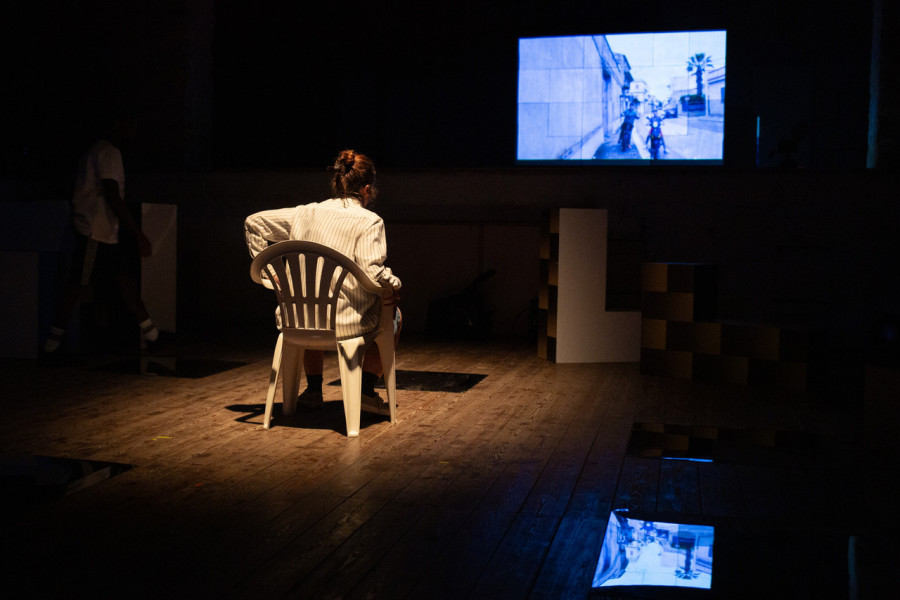
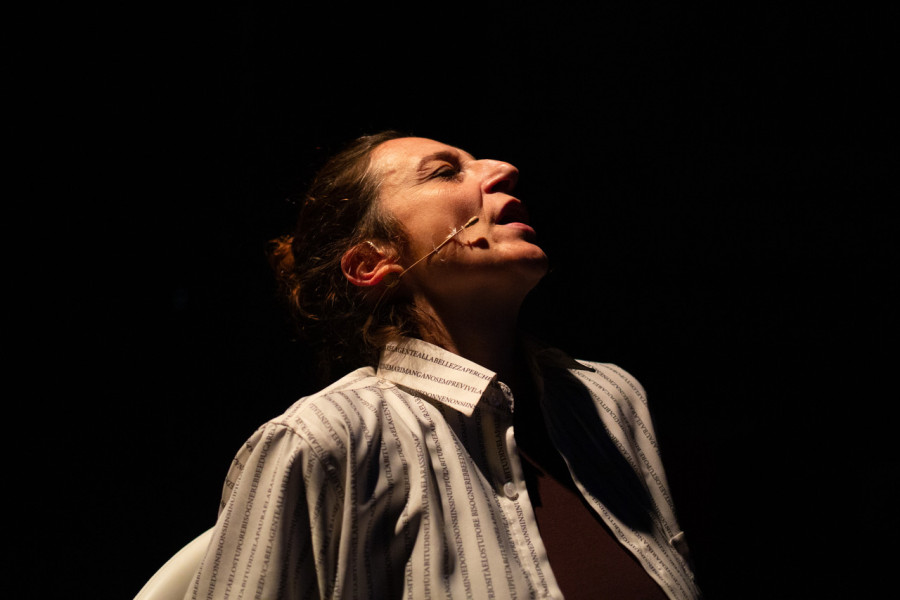
Campobello (Photo: Tito Puglielli)
Guest Performance Support


Main Supporters

euro-scene leipzig is institutionally supported by the City of Leipzig and the Saxon State Ministry for Higher Education, Culture and Tourism. Co-financed by tax revenue on the basis of the budget approved by the Saxon State Parliament.