
NKUL NNAM
Athena Lucie Assamba (Montréal)
European premiere | Québec Focus | English and French | No translation | No language skills required | No age restriction | Includes strobe effects
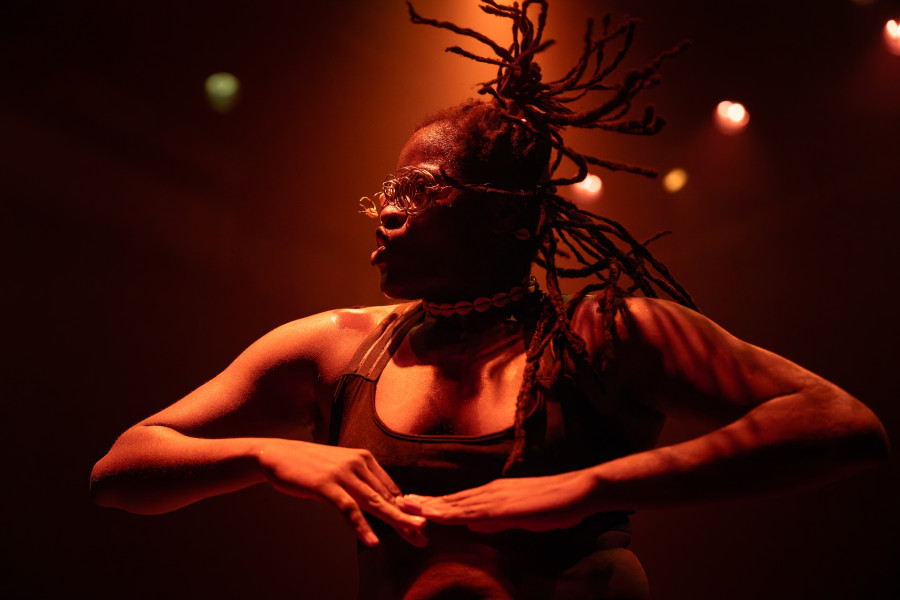
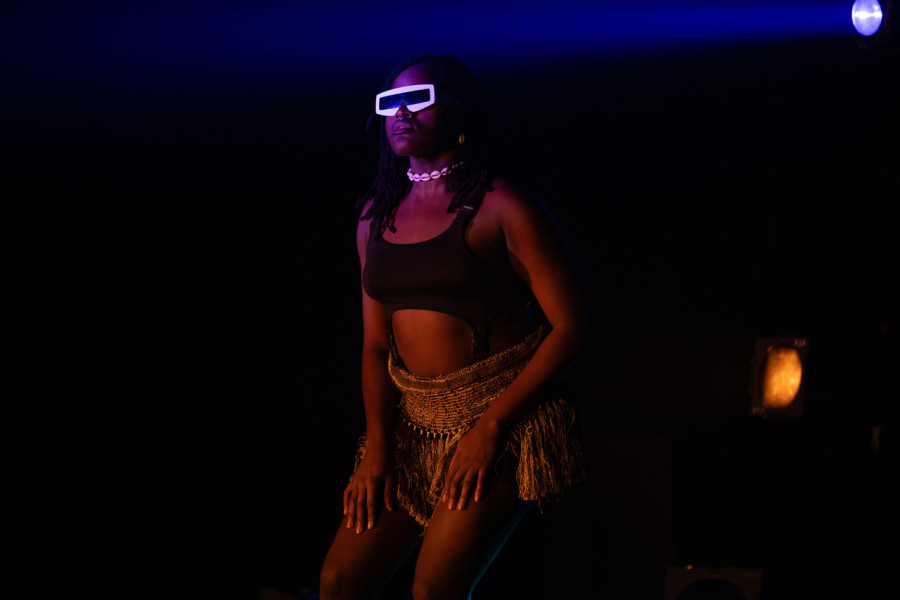
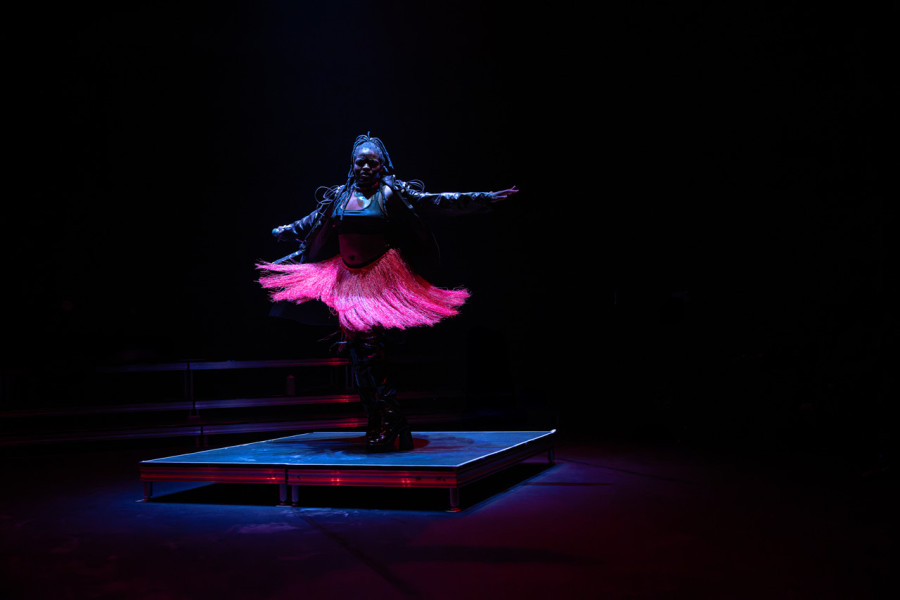
NKUL NNAM is perhaps the most surprising discovery from Montréal! The fascinating Athena Lucie Assamba appears like a priestess arriving from the future. In her ritual for the youth of the metropolis, drums, dances and the rhythmic poetry of her Cameroonian ancestors merge with the sense of freedom of today’s clubbing scene. The dancer and singer unfolds a presence of extraordinary intensity, as though an entire community were sweeping across the stage, accompanied by live electronic music and the rhythm of traditional Ngoma drums from Central Africa. The title itself means: The Drum of the Village. And its magic is infectious. The audience stands or sits and moves freely, as in a nightclub. Assamba turns her stage into a dance floor and immerses herself in the currents of Afrofuturism, where sacred and archaic heritage meets Africa’s leap into the future. Anyone who thought village community and rave parties in the club world of young people were mutually exclusive is proved wrong here – or danced into a different view. In styles including waacking, dancehall and Afro-house, ecstatic and mystical moods create experiences that are at once ceremonial and communal, connecting the audience with the futuristically performing priestess. Assamba is, in fact, also a Master of Ceremonies in Montréal’s underground scene. In NKUL NNAM, she invites us to a healing ritual that proves unforgettable.
Biographie Athena Lucie Assamba
Athena Lucie Assamba is a Cameroonian multidisciplinary and interdisciplinary artist, performer, choreographer, and emerging dance researcher based in Montreal. Her practice is rooted in traditional and contemporary African dances, street dance, and interdisciplinary creation. Through movement, music, voice, and performance, she explores ancestry, spirituality, healing, freedom, and African cultural imaginaries. Drawing from both ancestral and contemporary movement practices, her work investigates the mysticism of the African essence—its spirituality, culture, imagination, and multiple states of existence. A graduate in Neuroscience, Athena is interested in exploring the healing potential of movement and art, while engaging with ancestral knowledges and those that have remained untransmitted. Currently training at Nyata Nyata under Zab Maboungou and an alumna of École des Sables, she continues to revisit and deepen her understanding of the foundations of African dance and embodied knowledge.
Article by Léa Villalba on NKUL NNAM
NKUL NNAM is an opportunity to create a journey between the Montréal club and a village in Cameroon
“When I enter a club, a party or an event, the music allows me to experience things I do not have access to in everyday life. The darkness, the small lights, the dancing bodies, the music carrying you away, the fact that people know each other and at the same time do not know each other – all of this makes it possible to travel into other spheres of the universe,” says Athéna “Empress” Lucie Assamba.
Repeatedly experiencing these festive spaces inspired her to create a piece about them: Nkul Nnam. She quickly made a connection with her village of origin in Cameroon. “Clubs are very similar to the dance circle we had back home. A spirit can enter the circle, and at that moment another world comes into being. It allows for a state of trance, a liminal state. Africa has never stopped dancing or creating these circles, where many dances of freedom and resistance were born. For me, the club is the urban version of the dance circle,” says the artist, who has now been devoting herself fully to dance for three years.
Before that, Athéna studied neuroscience, but dance had always been part of her life. “I have been dancing since before I was born, because dance is an integral part of my culture. From a very early age, I learnt traditional dances from Cameroon that are performed at family gatherings, such as Bend Skin or Bikutsi. Later, I became interested in African street dance styles such as Coupé-Décalé and Mbolé,” Athéna explains. After moving to Montréal in 2015, she also became interested in Dancehall and Waacking.
In Nkul Nnam, Athéna draws inspiration from these different styles, but focuses above all on Bikutsi. “It is a way of paying tribute to this traditional Cameroonian dance, which is also the name of a rhythm. The dance was created by women who used the stamping of their feet to express themselves at a time when they did not have the right to speak in the territories of the Béti peoples,” says the dancer, who has trained at the École des Sables in Senegal and takes classes with the Nyata Nyata company.
With this work, she wanted to bring Bikutsi into a contemporary context – somewhere between choreography and improvisation.
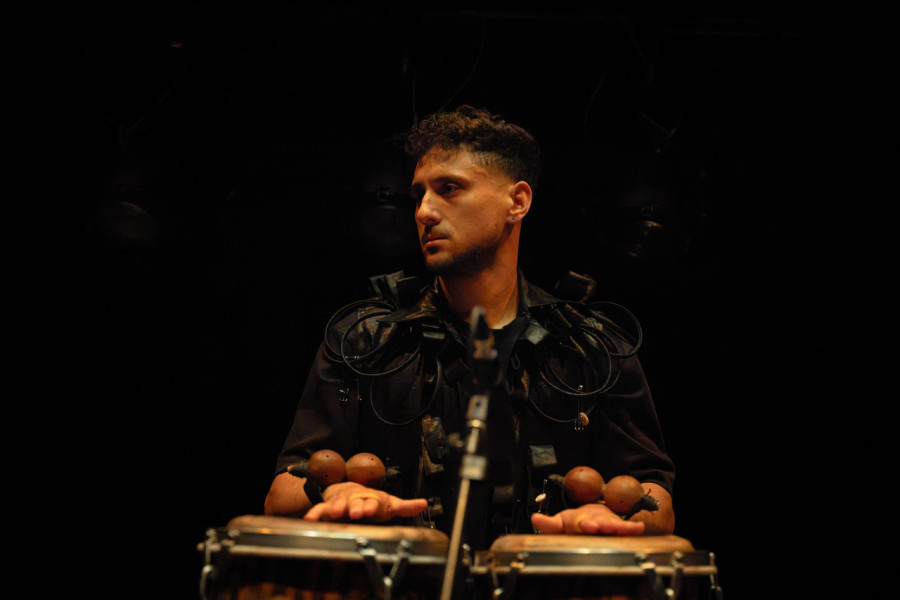
A DJ also appears on stage, and for Athéna she is “a character in her own right”. “I do not consider this piece a solo. I am the only one dancing, but the music and the DJ are there with me too. I also share the moment with the audience, so in the end everyone participates. In the future, I would also like to add a musician,” she says. “As far as the dance is concerned, I needed to begin the exploration on my own, but in a few years I can imagine several people embodying this work.”
Before Athéna herself comes on stage, she has invited her friend Aïchatou Erna Labarang to perform the first part of the evening. “Over the past few years, we have had many conversations, both personally and artistically, and we started a project together called Essence. Here, in a way, we each present our own version of our Essence,” she says.
For Athéna, Aicha’s piece Sens inverse fits very well with her own work. “It opens up the possibility of resisting the time we live in – the time in which we think we are supposed to live and function. Her piece creates a sense of infinity, and that sets up the subject very well,” the choreographer explains.
GIVING SPACE TO “AFRICANFUTURISM”
Alongside exploring the connections between the Cameroonian village and the club, Athéna also wants to place Africanfuturism at the heart of her work. “My definition changes every day, but when I think about it, the expression ‘saga of time’ comes to mind. It is about exploring and experiencing time in a circular rather than linear way. Past, present and future coexist within the same state, and we have to navigate through them every day,” she says.
The connection to her ancestors is also central to her research. “We tend to push tradition and the past to one side, as if they no longer evolve. But in Africa, we continue to live them. So today’s tradition is not the same as it was 15 years ago. The experiences of the past are useful information for those of us who are still here and for those who will come after us,” she adds.
The concept of technology also plays an important role in Athéna’s exploration of dance and its different dimensions. “Our ancestors already had the connection to nature and ecology that we talk about so much today. Nature informs science, and all the experiences of the past are science. They gave rise to ancestral technologies. How can we imagine a future with ancestral technologies? That is what I am searching for in dance and in different areas of my life.”
With Nkul Nnam, Athéna hopes to open a door for the audience onto these different questions and her recent research. “I would like to spark something in the audience – an impulse towards liberation and towards community. I would also like us to create a sense of community in that moment, for people to travel and to experience something of the circularity of time,” she concludes.
Léa VILLALBA (https://www.alloladanse.com/articles/festival-phenomena-se-livrer-a-la-circularite-du-temps?utm_source=chatgpt.com)
Credits
Artistic Direction + Choreography + Performance Athena Lucie Assamba Music conception + Performance Elli Miller-Maboungou Costumes + Scenography Athena Lucie Assamba Light Tiffanie Boffa Artistic + Dramaturgical advice Aïchatou Erna Labarang External eyes Aïchatou Erna Labarang, Lamine Cissoko, Mara Dupas Guest Performance Support Conseil des arts et des lettres du Québec (CALQ), Vertretung der Regierung von Québec in Berlin Creation OFFTA, Montréal, 26. Mai 2026
Production Athena Lucie Assamba Koproduktion ANCESTRALEMENT VOTRE Funding Conseil des arts et des lettres du Québec (CALQ), Conseil des arts de Montréal (CAM)
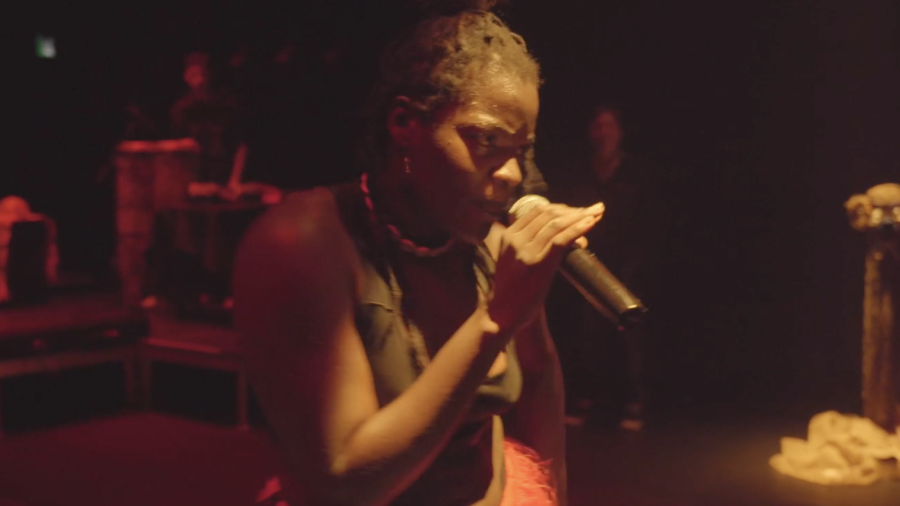
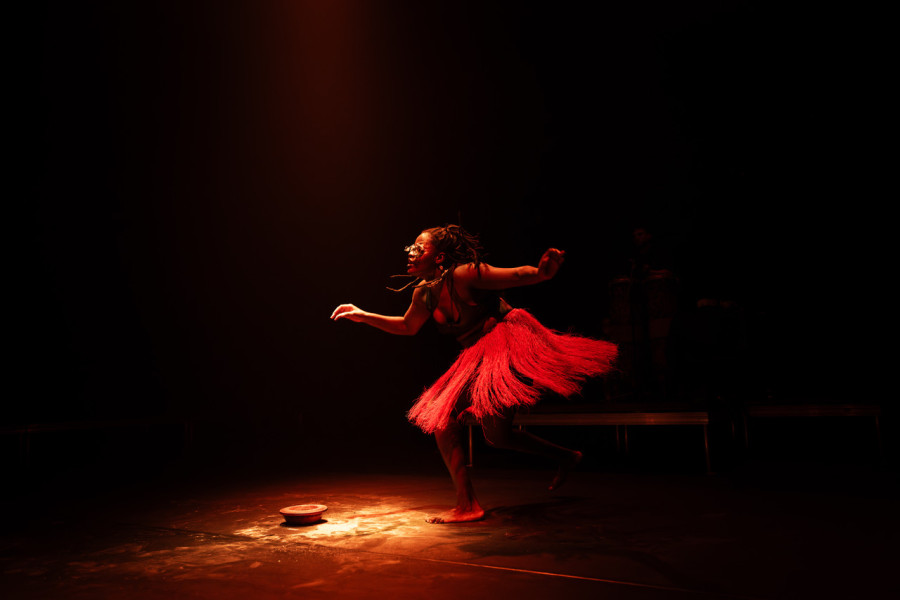
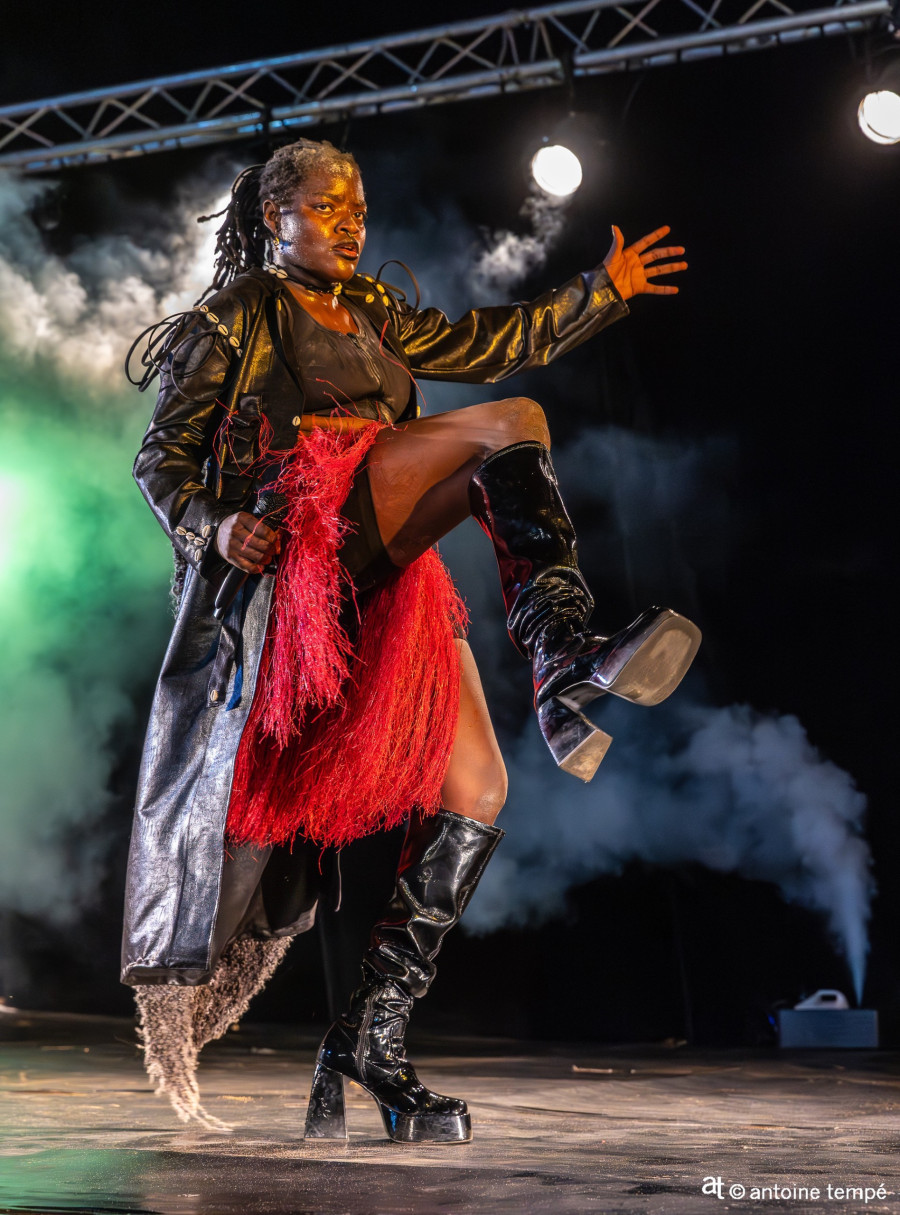
NKUL NNAM (Photos: David Wong, Steffi Boucher)
Guest Performance Support

Vertretung der Regierung von Québec in Berlin
Main Supporters

euro-scene leipzig is institutionally supported by the City of Leipzig and the Saxon State Ministry for Higher Education, Culture and Tourism. Co-financed by tax revenue on the basis of the budget approved by the Saxon State Parliament.