
2par2
Ebnflōh / Alexandra ‚Spicey‘ Landé (Montréal)
Festival closing | European premiere | Québec focus | No spoken language | Recommended for ages 12+
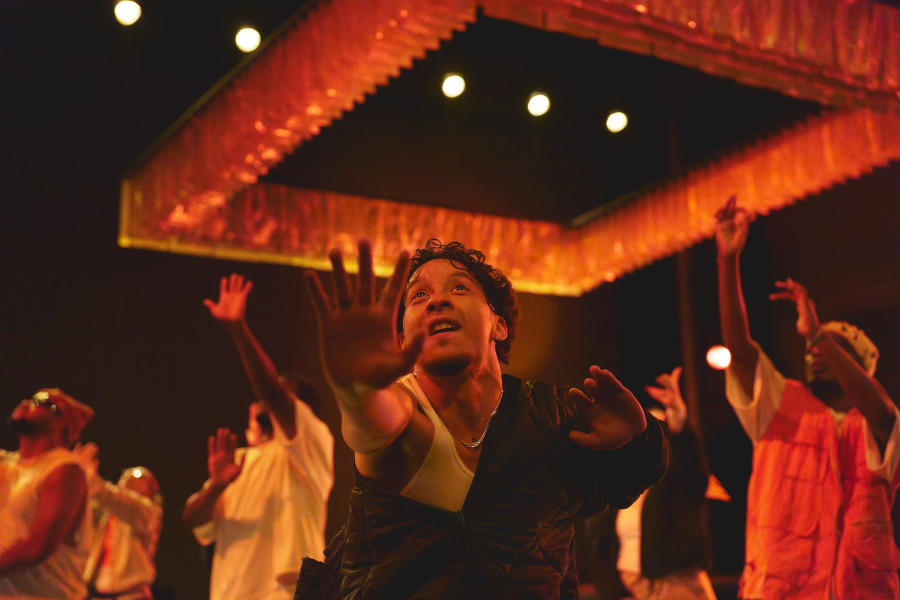
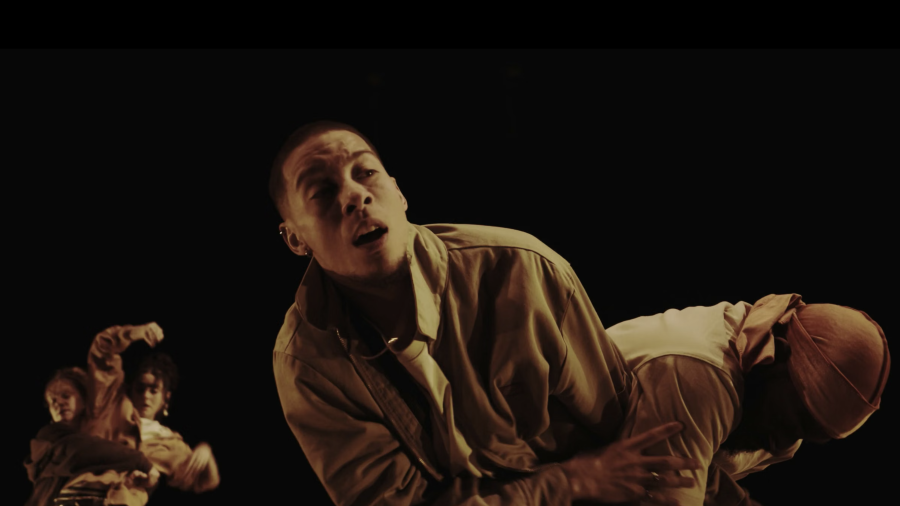
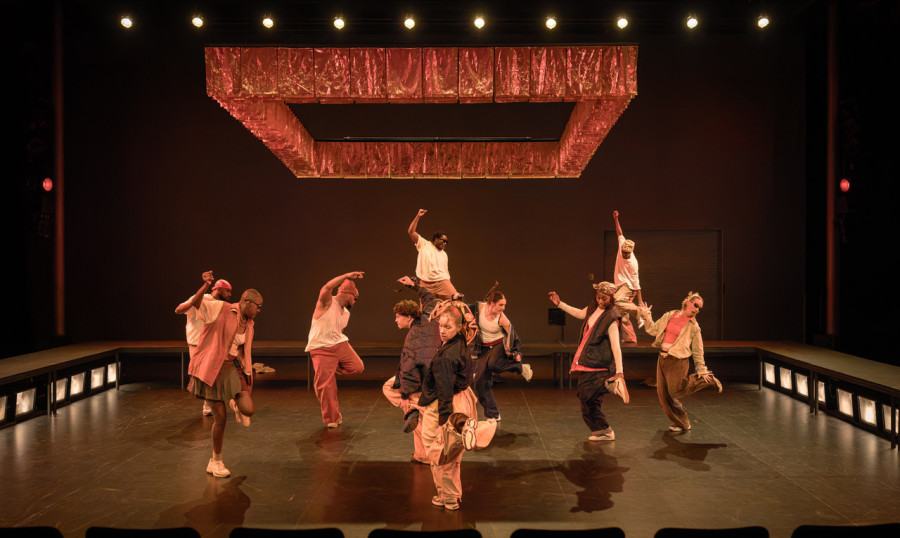
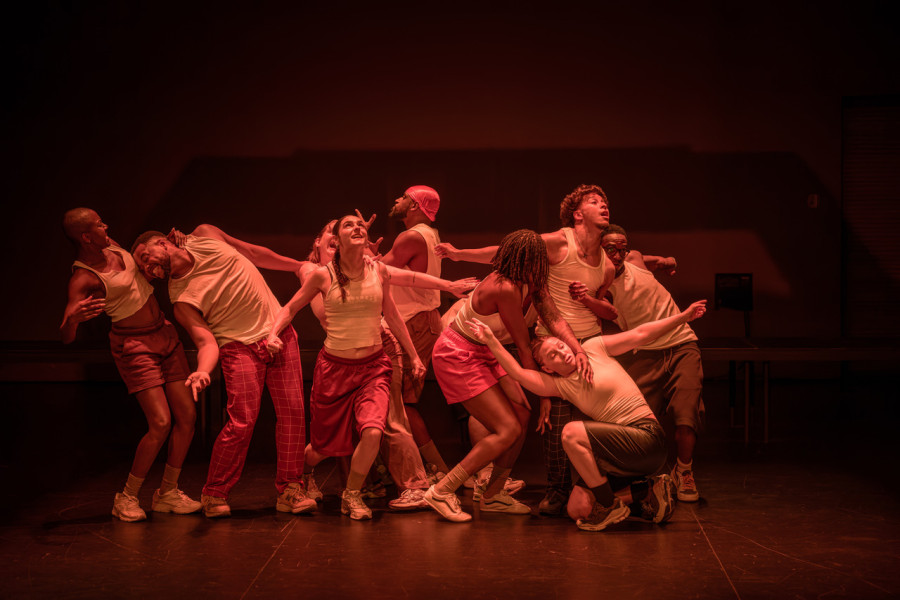
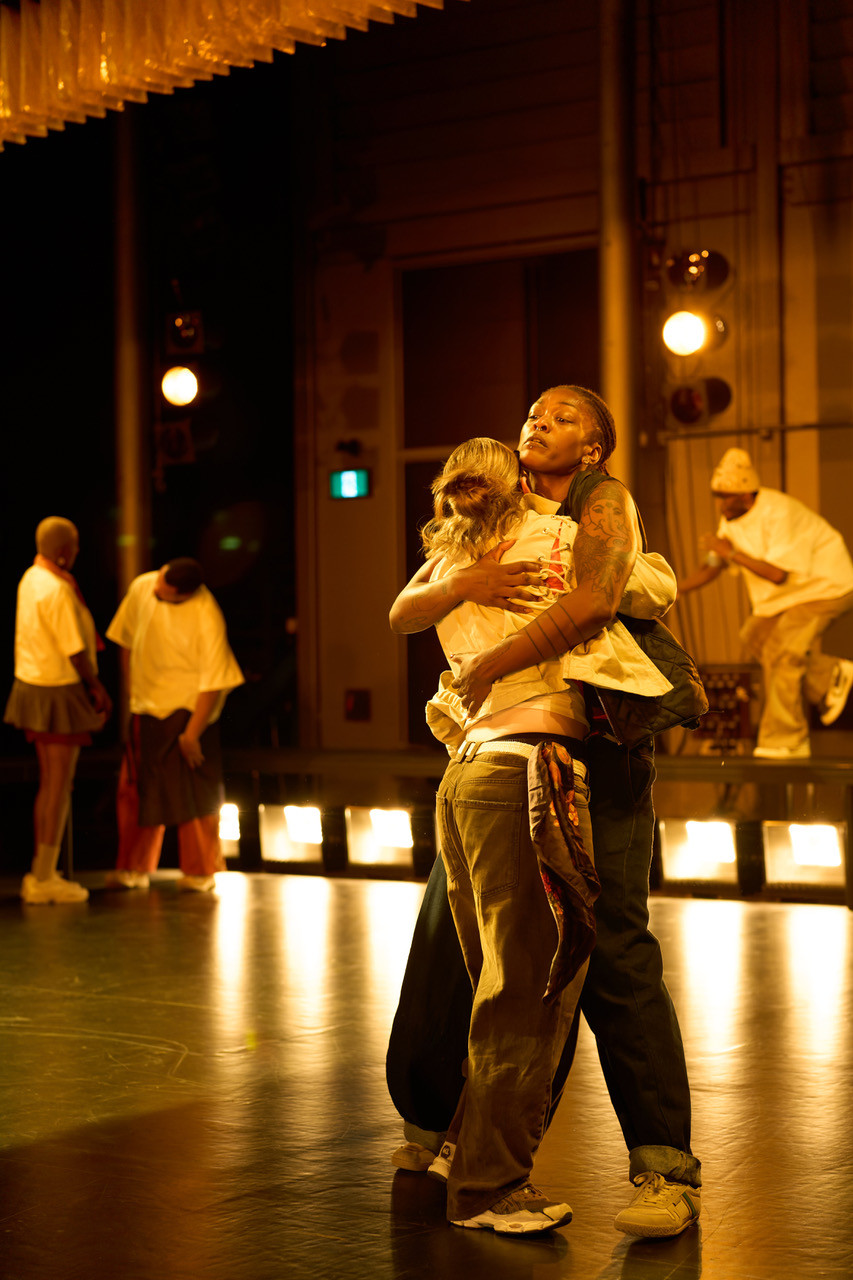
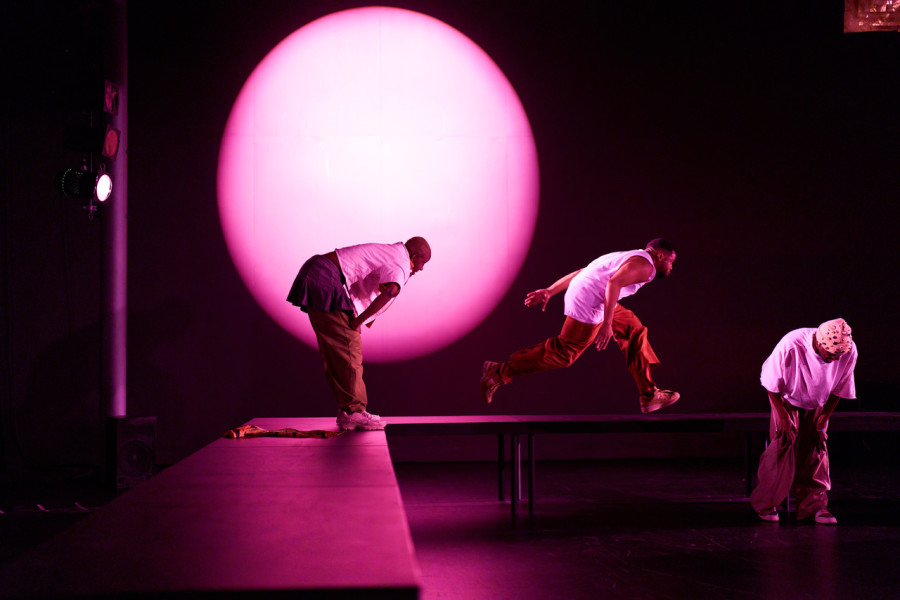
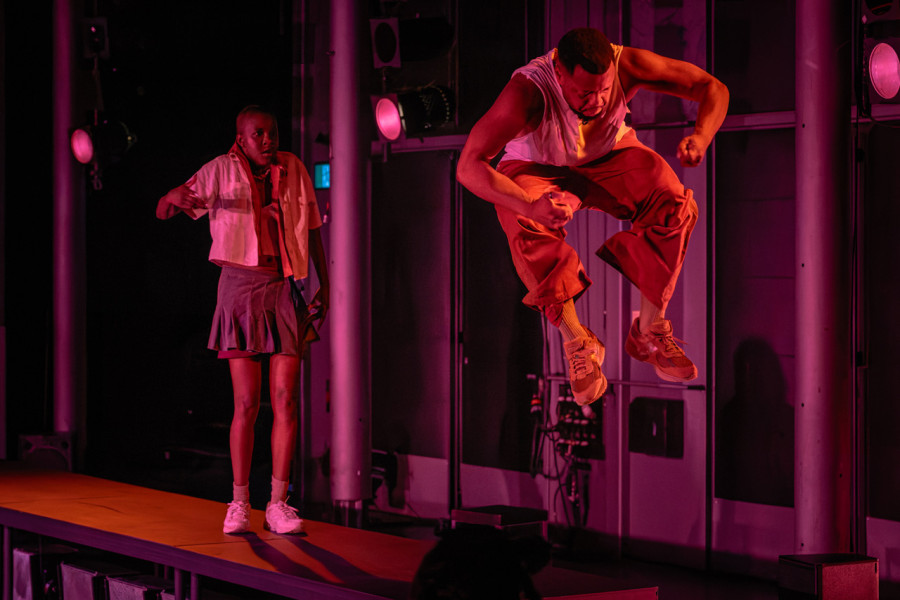
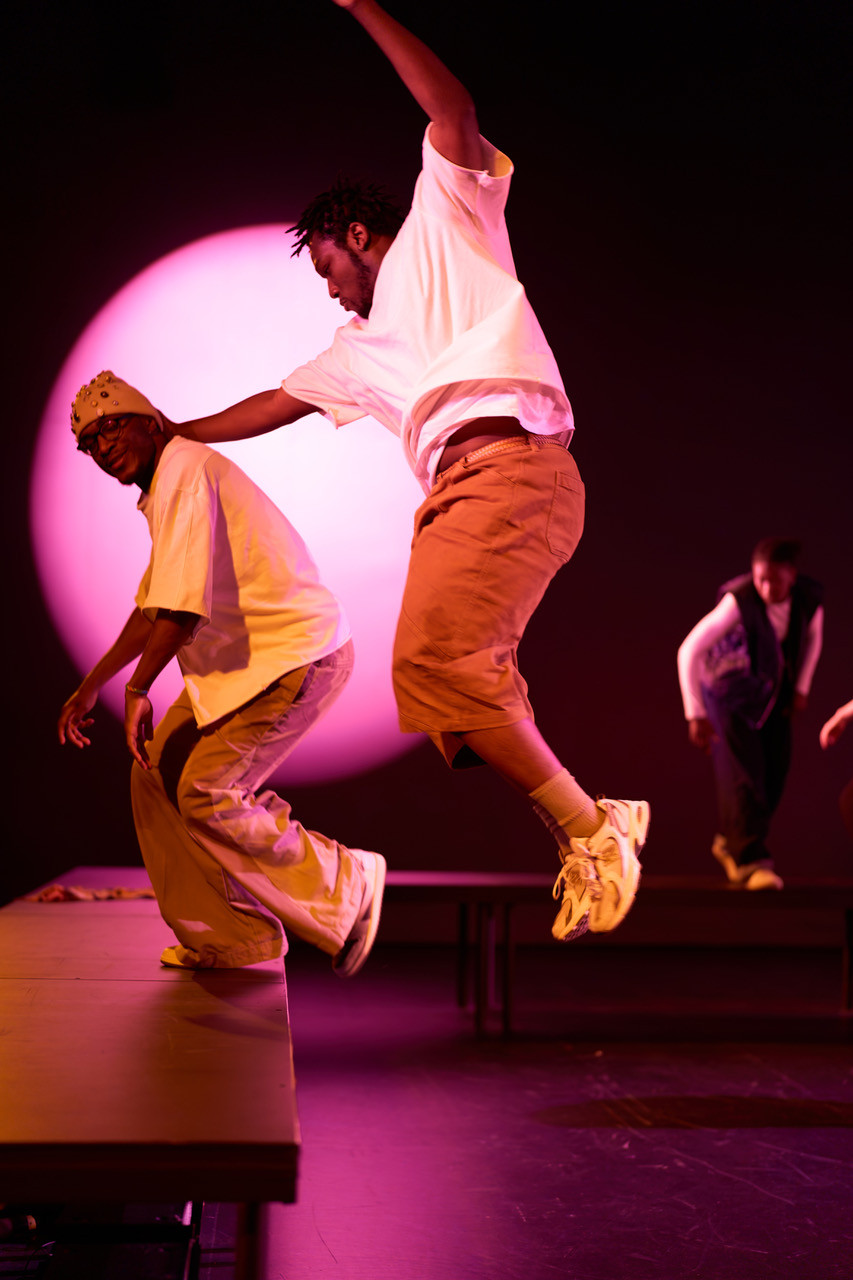
Sometimes as couples, sometimes as a community: in 2PAR2, Alexandra “Spicey” Landé explores the vast, almost impossible-to-map spectrum of emotions and conflicts that arise as couples, cliques and families navigate their relationships. We can sacrifice ourselves for another person – or destroy them. The piece moves between tenderness, love and violence, across private and public spaces. The performers wear contemporary streetwear, yet at times seem to have stepped out of a Baroque painting.
The ten dancers from Québec’s hip-hop scene impress not only with virtuosic duets and solos but also with their acting. They laugh, cry and swear; the result can be absurd, comic or tragic, ecstatic or playfully exaggerated. With a sure instinct, Alexandra “Spicey” Landé has brought together a company that combines street dance and contemporary dance theatre with remarkable ease.
She also draws on her own biography. Alexandra was only nine months old when her parents moved with her from Haiti to Canada. How does such an early experience of uprooting affect a person’s later relationships? What experiences have shaped the dancers and continue to resonate in their relationships? In the end, life plays with us all. Today Landé is one of Montréal’s distinctive choreographic voices, increasingly present on international stages.
Interview with Alexandra ‘Spicey’ Landé, 2026
2par2 focuses on pairs that form within a larger group. Is this a way of tackling the complexity of life as a couple?
The piece is about the dynamics of relationships involving two people, but I didn’t limit myself to examining heteronormative couples. I wanted to broaden the scope to cover all two-person relationships, including parent-child dynamics and obligatory social relationships. I’m interested in how relationships are formed, whether short- or long-term, and the impact they have on people. I was also inspired by my parents’ experience of immigration. They left Haiti for Quebec on December 25, 1976, bringing me with them at the age of nine months. My three brothers stayed in Haiti, then joined us four years later. I wonder how my parents managed to leave some of their children behind and escape Papa Doc’s regime. Upon arriving here, they stayed with a cousin of my mother, then lived for eight years in a 4½ apartment. They worked in factories to make sure we had enough to eat and give us a better life while dealing with racism and poverty. Under those circumstances, how do you make a life for yourself as a couple? You don’t have a choice. I’m interested in this inseparable pair, and I also imagine what I call the “king’s court”: how the couple’s relationship is perceived by the rest of the world. Each of them has their own place, significance, and way of presenting themselves to the world. The piece is like a big family gathering in which familiar relationships conceal tension and unease, which eventually manifest in the social dynamics: two brothers who compete with each other, a couple whose relationship is falling apart, a mother and daughter with a complex relationship. I’m also interested in the perspective of the individual within a relationship: the tendency toward egoism and narcissism, which makes us want to transform the other person so they will be more like us.
How did you handle improvisation, which is an inherent part of Hip Hop dance, within the choreographic restrictions of this piece?
There were two levels to the writing: it was both micro, as each of the five pairs has its own trajectory and develops its own dynamic, and macro, as each pair is integrated into the group dynamic. It was challenging to develop the dramaturgy for each pair along with images of the whole group. I didn’t want to create a cacophony or total chaos, but I did want to leave some room for disorder. I want us to work together with a common purpose and raise political issues, real moments in human life that involve interpersonal dynamics, tension, and the desire to be with others or be alone. It’s a major challenge for street dancers to perform together in pairs like this for an hour. My job was to create a structure that would let them be free in the moment. For me, there are no mistakes in the performances, because the tensions created by the choreography allow for slips, for life to enter the work. I’m not interested in choreography where everything is carefully positioned and calculated to the second. I’m looking for moments where the dancers can be themselves and express something personal. I want to stay true to the spirit of Hip Hop, with its rawness, but also to the reality of the dancers’ lives. I’m interested in capturing their perspective through the Hip Hop body, in the place where their dancing and their personal lives meet, which is difficult to find. Dance becomes a tool you use to create a world that embodies life experience, so that the dancer will put their own stamp on it. When there is contact between dancers in the piece, I asked them to imagine that the contact is like a real relationship, which is not perfect. We choreograph it, but I’m looking for moments of real physicality that are not too aesthetically slick. Hip Hop dance has a power, a palpable energy that’s related to the music. For this piece, it was created by Shash’U, who’s been my composer for 15 years and has his own story. It’s music whose roots are in the South Bronx, created by people who had nothing and invented this language that created a community, gave them strength, and inspired a sense of pride.
You were one of the first choreographers in Quebec to feature Hip Hop and street dance in contemporary dance venues. What challenges did that pose?
I try to highlight elements of Hip Hop culture that are less obvious—implications, layers, and nuances to which people don’t always have access, filtered through my perspective as a black woman. My viewpoint affects how I see many things, which brings a political dimension to my work. I showcase the values and energy of Hip Hop dance and also delight in deconstructing them. It’s a fine balance. For a long time, the dominant paradigm in dance was of the great choreographer surrounded by dancers who perform at his or her bidding. However, more and more choreographers are no longer able to deny performers’ contributions to their work. Hip Hop dancers train hard and are passionate about their dancing, wanting to become better freestylers, compete in battles, and gain recognition. I try to lead them somewhere different. It’s a big challenge. Unlike contemporary dancers, who learn how to work under a choreographer, Hip Hop or street dancers don’t care about that, so the relationship isn’t an easy one for them. A lot of Hip Hop was developed in commercial settings where the choreographer was paid more than everyone else. The first challenge was to get them to trust me, so that I could lead them in a direction that was unfamiliar but would speak to them and take them to the next level.
Interaction with the audience is an important part of your work. What is the reason for this?
I think it’s important to engage with the audience to make them less passive. I want the audience to work, to be more than just a voyeur attending a show, especially since there are black bodies on stage. There’s a whole history behind this scenario of white people watching black people entertaining them—like Josephine Baker, for example, or blackface. Black people entertained white people in the United States for years. People have a similar relationship to Hip Hop as well, which is viewed as entertainment. That’s why I want to interact with the audience, so that it becomes a two-way relationship: we entertain the audience, but they will also entertain us. In a piece about the dynamics of two-person relationships like 2par2, getting the audience involved was a given. It makes things a little less comfortable and makes attendance a more conscious experience.
Interview by Elsa Pépin (https://fta.ca/en/news/entretien-avec-alexandra-spicey-lande-2026)
Credits
Choreographer + Artistic Director Alexandra ‚Spicey‘ Landé In Collaboration with the Performers Jaleesa ‚Tealeaf‘ Coligny, Christina ‚Hurricane Tina‘ Paquette, Delande ‚Djüngle‘ Dorsaint, Elie-Anne ‚Rawss‘ Ross, Nindy Banks, Kalliane ‚Yofi‘ Brémault, Anthony ‚Palomecc‘ Palomeque, Rweg ‚Halfido‘ Dantiste, Frank ‚21‘ Amisi, Brandonson ‚Bee‘ Nesifort Music Composer Richard ‚Shash‘U‘ St-Aubin Lighting Designer Leticia Hamaoui Set Designer + Scénographe Anick La Bissonnière Costume Designer Nindy Banks Fashion Designer Cristian Perez-Boudon Assistenz Bühne Eliane Cordeau Technical Director + Assistant Lighting Emmanuel Bossé-Messier Soundscape Delande ‚Djüngle‘ Dorsaint Rehearsal Director + Coach Frédérique ‚Pax‘ Dumas, Jean-Édouard ‚Darqk‘ Pierre Toussaint, Stéphanie Decourteille Acting Coach Étienne ‚Atn‘ Lou Artistic Advisor Helen Simard Dramaturgical Support Mathieu Leroux Outside Eye Frédérique ‚Pax‘ Dumas, Natasha Jean-Bart Coordination Kaia Mienna Technical Director Rehearsal Vladimir Cara Booking Agence Résonances, Chalmont Agentur Gastspielförderung Conseil des arts et des lettres du Québec (CALQ), Conseil des arts du Canada (CAC), Vertretung der Regierung von Québec in Berlin Creation Festival TransAmériques – FTA, Montréal, 6. Juni 2026
Production Ebnflōh, Executive Producer: Parbleux Co-production Festival TransAmériques – FTA, Montréal, fabrik Potsdam, National Creation Fund of the National Arts Centre of Canada, National Arts Centre, Ottawa Support Atelier de Paris / CDCN Funding Conseil des arts du Canada (CAC), Conseil des arts et des lettres du Québec (CALQ), Conseil des arts de Montréal (CAM)
Photos: David Wong, Murielle ‚Truly‘ Bien-Aimé
Guest Performance Support

Vertretung der Regierung von Québec in Berlin
Main Supporters

euro-scene leipzig is institutionally supported by the City of Leipzig and the Saxon State Ministry for Higher Education, Culture and Tourism. Co-financed by tax revenue on the basis of the budget approved by the Saxon State Parliament.